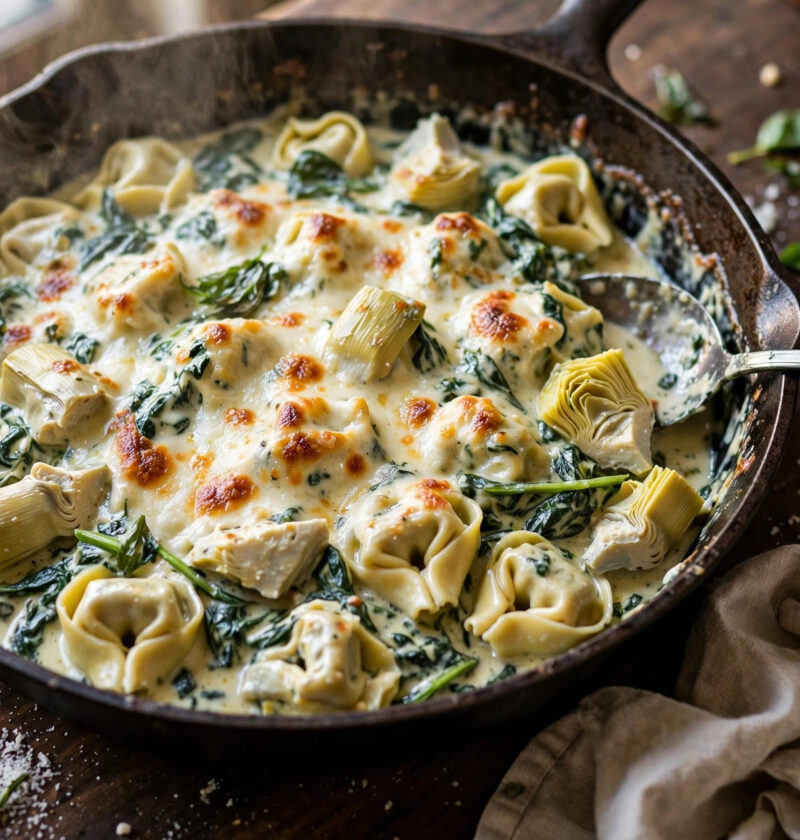
Imagine your favorite spinach artichoke dip — the creamy, garlicky, cheesy one everyone hovers around at parties — decided to grow up into a full dinner. That’s this dish. Plump cheese tortellini simmered directly in a luscious sauce of cream cheese, Parmesan, garlic, tender spinach, and briny artichoke hearts, all in a single pot, finished under a blanket of melted mozzarella that’s just begging for a spoon. It tastes like comfort food royalty, but the whole thing is on the table in 25 minutes with exactly one pot to wash.
Here’s the real trick: the tortellini cooks right in the sauce. As it simmers, the pasta releases its starches into the liquid, thickening it into a silky, clingy sauce that no separate pot of pasta water could ever give you. The artichokes add a briny, almost lemony brightness that keeps the richness from feeling heavy, and the wilted spinach folds in at the end for color and freshness. It’s vegetarian, it’s weeknight-fast, and it’s the kind of dinner that gets requested by name.
Why You’ll Love This Recipe
- One pot, truly: The tortellini cooks in the sauce, the sauce thickens from the pasta starch, and there’s no colander, no second pot, no separate anything. Dinner and cleanup both stay in one place.
- Spinach artichoke dip meets pasta night: All the creamy, garlicky, cheesy flavors of the beloved party dip, transformed into a hearty main dish. If you love the dip, you will lose your mind over this.
- 25 minutes, start to finish: Sauté, simmer, stir, serve. This is faster than most delivery and infinitely more satisfying.
- Vegetarian crowd-pleaser: Hearty enough for committed carnivores (the artichokes and cheese bring serious substance), friendly for vegetarians, and easy to adapt for picky eaters.
- Pantry-and-freezer friendly: Canned artichokes, frozen spinach, refrigerated tortellini — the core of this dish lives happily in your kitchen for weeks, ready whenever a craving strikes.
Tools You’ll Need
- Large deep skillet or Dutch oven (at least 12-inch, with a lid)
- Wooden spoon or silicone spatula
- Chef’s knife and cutting board
- Measuring cups and spoons
- Colander or fine-mesh strainer (for the artichokes and spinach, if using frozen)
Ingredients
For the Base
- 1 tablespoon olive oil
- 1 tablespoon unsalted butter
- 1 medium yellow onion, finely diced
- 4 cloves garlic, minced
- 1/2 teaspoon kosher salt, plus more to taste
- 1/4 teaspoon freshly cracked black pepper
- 1/4 teaspoon red pepper flakes (optional, for warmth)
- 1 teaspoon Italian seasoning
For the Creamy Sauce
- 8 oz (225 g) cream cheese, softened and cut into cubes
- 2 1/2 cups low-sodium vegetable or chicken broth
- 1 cup heavy cream
- 1 can (14 oz) artichoke hearts, drained and roughly chopped
- 1 cup freshly grated Parmesan cheese, plus more for serving
- 1/2 teaspoon Dijon mustard (trust me)
For the Tortellini and Finish
- 20 oz (about 565 g) refrigerated cheese tortellini
- 4 cups fresh baby spinach (or 10 oz frozen spinach, thawed and squeezed very dry)
- 1 1/2 cups shredded low-moisture mozzarella cheese
- 2 tablespoons chopped fresh basil or parsley, for garnish
- Lemon wedges, for serving (optional but bright)
How to Make One-Pot Creamy Spinach Artichoke Tortellini
Step 1: Soften the aromatics
Heat the olive oil and butter in a large deep skillet or Dutch oven over medium heat until the butter foams. Add the diced onion and cook for 4–5 minutes, stirring occasionally, until soft, translucent, and just starting to turn golden at the edges. Stir in the garlic, salt, pepper, red pepper flakes (if using), and Italian seasoning, and cook for 45–60 seconds until fragrant. Don’t let the garlic brown — fragrant and pale is the goal; browned garlic turns bitter and will haunt the whole sauce.
Step 2: Build the creamy base
Drop the heat to medium-low and add the cubed cream cheese, stirring until it begins to soften and melt into the onions — about 2 minutes. It won’t be perfectly smooth yet, and that’s fine. Pour in the broth a little at a time, whisking or stirring vigorously as you go, until the cream cheese dissolves into a smooth, pale base. Then stir in the heavy cream and the Dijon mustard. The Dijon is invisible in the final dish but it sharpens all the dairy flavors and keeps the sauce from tasting flat. Bring the mixture to a gentle simmer — small lazy bubbles around the edges, not a rolling boil.
Step 3: Add the artichokes and tortellini
Stir in the chopped artichoke hearts and the Parmesan cheese until the Parmesan melts into the sauce. Taste the sauce now and adjust the salt — the artichokes and Parmesan both bring saltiness, so you may need less than you think. Add the tortellini and stir gently to coat every piece, making sure the pasta is mostly submerged. If a few pieces peek out, that’s fine — you’ll stir during cooking. Cover with the lid and simmer for 7–9 minutes, stirring once or twice, until the tortellini is tender and the sauce has thickened noticeably. Fresh tortellini cooks fast, so start checking at 6 minutes.
Step 4: Wilt the spinach
Uncover and stir in the fresh spinach a handful at a time, letting each addition wilt into the hot sauce before adding the next. It looks like an absurd mountain of greens at first — then, in about 2 minutes, it melts down into silky ribbons throughout the sauce. (If using frozen spinach, make sure it’s squeezed bone-dry first — press it in a clean kitchen towel until no more water comes out — then stir it in and heat through for 2 minutes.) The sauce should now be thick enough to coat a spoon heavily. If it’s too thick, splash in a little more broth; too thin, simmer uncovered for 2–3 more minutes.
Step 5: The mozzarella finish
Take the skillet off the heat. Sprinkle the shredded mozzarella evenly over the top, cover with the lid, and let it stand for 3–4 minutes. The residual heat melts the mozzarella into a gooey, stretchy blanket without any risk of the dairy breaking or turning grainy — this off-heat melt is the secret to a silky finish. Uncover, give it one gentle stir to marble the melted mozzarella through the top layer (don’t over-stir or you’ll lose the beautiful cheese pull), and shower with fresh basil or parsley.
Step 6: Serve
Spoon into warm bowls straight from the skillet, making sure everyone gets plenty of sauce — this is a saucy dish and the sauce is the point. Pass extra Parmesan, the red pepper flakes for heat lovers, and lemon wedges for anyone who wants brightness. Serve immediately while the mozzarella is at peak stretch. Garlic bread on the side is strongly encouraged for sauce-mopping duties.
Tips for the Best Results
- Soften the cream cheese first. Cold cream cheese seized into hot liquid turns lumpy and never fully smooths out. Leave it on the counter for 30 minutes, or microwave the cubes for 20 seconds. Room-temperature cream cheese melts into the sauce like a dream.
- Grate your own Parmesan and mozzarella. Pre-shredded cheeses are coated with anti-caking starch that makes sauces grainy and dull. Freshly grated melts into a glossy, restaurant-quality sauce. This matters more here than in almost any other recipe.
- Squeeze frozen spinach like you mean it. Watery spinach is the number one cause of thin, sad creamy sauces. Thaw it, then wring it out in a clean kitchen towel until it stops dripping. It should feel almost dry.
- Don’t boil the sauce hard. A vigorous boil can break the cream sauce into a greasy, separated mess. Keep it at a gentle simmer — lazy bubbles — especially after the dairy goes in.
- Undercook the tortellini slightly. It keeps absorbing sauce as it stands, and nobody wants bloated, mushy pasta. Pull it when it’s just tender with the tiniest bite left.
- Salt in layers, taste at the end. Broth, Parmesan, and artichokes all bring salt. Season lightly as you go and do your final adjustment after everything’s combined.
Mistakes to Avoid
- Dumping all the broth in at once with the cream cheese. Cold liquid hitting the cheese all at once makes it seize into stubborn lumps. Add the broth gradually, stirring, and the base stays silky.
- Using marinated artichoke hearts. The oil-and-herb marinade overpowers the delicate sauce and makes everything greasy. Use plain artichoke hearts packed in water or brine, drained well.
- Overcooking the tortellini. Fresh tortellini goes from perfect to mushy in about 2 minutes. Set a timer, check early, and remember it keeps cooking in the hot sauce off the heat.
- Skipping the lid during the simmer. The lid traps steam that cooks the tortellini evenly and prevents the sauce from reducing too fast and scorching on the bottom. Lid on for the simmer, lid off for the final thickening.
- Stirring aggressively after adding the mozzarella. One gentle fold is all you need. Vigorous stirring breaks the melted cheese into strings that seize up instead of staying gloriously gooey.
Serving Suggestions
- Warm garlic bread or focaccia — the sauce is too good to leave in the bowl. Bread is not optional here; it’s equipment.
- Simple green salad — crisp romaine or mixed greens with a sharp lemon vinaigrette cuts through the richness and keeps the meal balanced.
- Roasted cherry tomatoes — their sweet acidity is a perfect foil for the creamy sauce. Roast at 425°F for 15 minutes with olive oil and salt.
- Grilled chicken strips on top — for the carnivores at the table, sliced grilled chicken breast turns this into an even heartier main without changing the recipe.
- Crisp white wine — a Pinot Grigio or Sauvignon Blanc. Or sparkling water with lemon for a non-alcoholic pairing that does the same brightening job.
Storage and Reheating
Refrigerator: Store leftovers in an airtight container for up to 4 days. The sauce will thicken considerably as it chills — that’s normal.
Freezer: This one doesn’t love the freezer — cream-based sauces can separate when thawed, and the tortellini gets soft. If you must, freeze for up to 1 month in a sealed container, and expect to whisk vigorously while reheating to bring the sauce back together. Fresh is genuinely better here.
Reheating: Warm gently on the stovetop over low heat, stirring often, with a splash of broth or milk to loosen the sauce back to creamy. The microwave works in 1-minute bursts at 50% power, stirring between each — high heat will break the sauce and turn the tortellini rubbery.
Frequently Asked Questions
Can I use frozen tortellini instead of refrigerated?
Yes. Add 3–4 extra minutes to the covered simmer time, and make sure the tortellini is fully submerged so it thaws and cooks evenly. There’s no need to thaw it first — just go straight from freezer to pot.
What can I substitute for heavy cream?
Half-and-half works for a lighter sauce, though it will be slightly less rich and a bit thinner — simmer an extra 2–3 minutes uncovered to compensate. For a lighter version, you can also use whole milk plus an extra ounce of cream cheese, but avoid skim milk; there isn’t enough fat to keep the sauce stable and it may curdle.
Can I add chicken or sausage?
Absolutely. Stir in 2 cups of shredded rotisserie chicken or sliced rotisserie chicken breast with the artichokes in Step 3. For raw chicken, dice 1 pound of chicken breast, sear it in the pot before the onions, remove, and add it back with the tortellini.
Why is my sauce too thin / too thick?
Too thin: the tortellini probably needed another minute or two to release its starch, or the spinach added water. Simmer uncovered for 2–3 minutes, stirring — it thickens fast at the end. Too thick: whisk in warm broth a quarter-cup at a time until it’s silky. Remember the sauce thickens a lot as it stands, so aim for slightly looser than you want in the bowl.
Can I make this ahead of time?
It’s best fresh, but you can prep the components: chop the onion, mince the garlic, drain and chop the artichokes, grate the cheeses, and keep everything refrigerated. Then the actual cooking is 20 minutes. Fully assembled leftovers reheat well for 2–3 days (see above), though the tortellini softens a bit — still delicious.
Recipe Card Data
- Prep Time: 10 minutes
- Cook Time: 15 minutes
- Total Time: 25 minutes
- Servings: 6
- Calories: ~620 per serving
- Course: Main Dish
- Cuisine: Italian-American
- Method: One-Pot / Stovetop